Conditions Ripe For Deadly Water Amoeba, Oklahoma Health Officials Say
Health officials are warning the conditions are prime for a rare but deadly amoeba that lives in Oklahoma Lakes and rivers.Wednesday, August 1st 2012, 6:36 pm

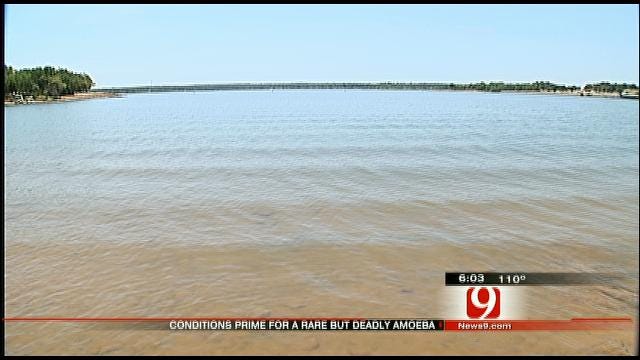
Health officials are warning the conditions are prime for a rare but deadly amoeba that lives in Oklahoma Lakes and rivers.
The warning comes after a 6-year-old boy died Tuesday afternoon from the waterborne illness referred to as PAM (Primary Amebic Meningoencephalitis). The death happened after the boy was swimming in the Red River on the Texas border.
That boy was from Bryan County in the southern part of the state. State Health officials say the boy was likely exposed the weekend of July 21.
PAM is caused when a one-celled organism, Naegleria fowleri, found naturally in most lakes and ponds, is forced up a swimmers nasal cavity. Swimmers are exposed when they dive or submerge their head in contaminated water. The amoeba then travels up the nose to the brain, where it destroys the brain tissue.
7/31/12 Related Story: Bryan County Child Dies Of Illness Caught While Swimming In River
The amoebas multiply rapidly in very warm and stagnant water. And Oklahoma Health officials warn conditions now are prime for the organism. But it is also very rare. Since 1998, six Oklahomans have died due to PAM. Victims are usually children.
"It always captures everyone's hearts and attention of course when a case of PAM is reported, but fortunately it is very rare," said Kristy Bradley, DVM, the state epidemiologist. "But we are wanting to [let Oklahomans know they are] because of the heat and lowering levels of the water that cause this organism to flourish."
Bradley says she is surprised no one died last year in Oklahoma of PAM. However a little boy in Kansas did die of the disease last August.
Symptoms of PAM initially include: high fever, headache, nausea, and vomiting. Later, symptoms may include stiff neck, seizures, hallucinations, and coma. PAM cannot be spread from person-to-person. Most occurrences of PAM occur in the southern states.
In most cases, victims are described as primarily young, healthy individuals who have actively participated in a recreational water activity three to seven days prior to onset of symptoms.
PAM is a severe illness that does not respond to routine treatments. However, in those rare instances where treatment has been successful, it was started very early in the course of illness. Death generally occurs from three to seven days following infection with the organism.
Health officials encourage Oklahomans to observe these water safety tips to avoid illness while swimming in lakes, rivers and other natural bodies of water:
- Avoid water entering nose or mouth when swimming, jumping, diving, or dunking your head into bodies of fresh warm water.
- Hold your nose or use nose plugs when jumping or diving into water.
- Never swim in stagnant or polluted water.
- Do not swim in areas posted as "No Swimming".
- Avoid swallowing water from rivers, lakes, streams, or stock ponds.
- Use earplugs, swim goggles, or masks if you tend to get ear or eye infections.
- Swim only in properly maintained pools, because chlorine rapidly kills the amoeba.

Get The Daily Update!
Be among the first to get breaking news, weather, and general news updates from News on 6 delivered right to your inbox!
More Like This


April 15th, 2024

April 12th, 2024

March 14th, 2024
Top Headlines

April 23rd, 2024

April 23rd, 2024

April 23rd, 2024

April 23rd, 2024